How to Warm Up During Phone Calls: A Quiet Routine for Loud Days
Active Living · The Home DrillMy telephone, like most people’s, has become the centre of my working day. Between school pickups, freelance calls, and that one cousin in Halifax who refuses to learn how to send a voice note, I spend somewhere between two and four hours a day with the receiver pressed against my shoulder. In my experience, those are the hours when the body quietly forgets it has a spine. So I decided to redesign them.
This is not a programme. It is a habit — a way of using the pauses inside a conversation as tiny doorways back into the body. Nothing here requires equipment beyond what you already own: a kitchen counter, a doorway, a yoga mat if you have one. According to experts at Harvard’s public health school, the most effective movement habits are the ones tethered to existing routines. Phone calls happen anyway. We may as well use them.
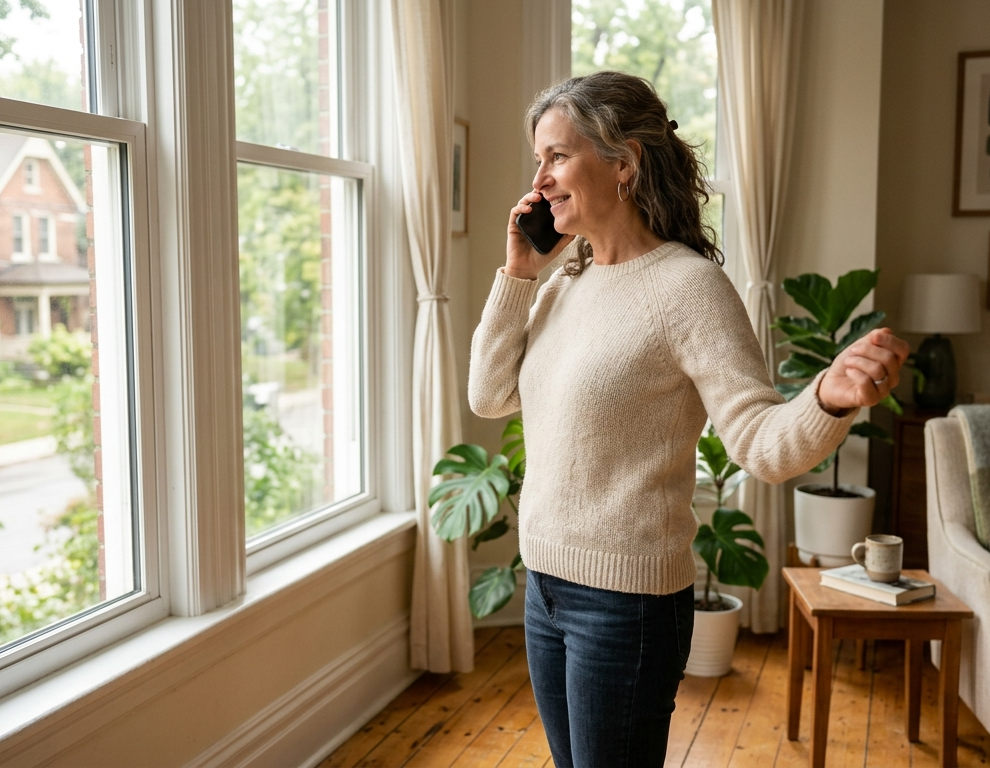
1. The Standing Switch: Why I Stopped Sitting Through Calls
For years I associated phone calls with sinking. The moment the ringer sounded I would lower myself into the armchair, prop my elbow on a cushion, and turn into a comma. Some calls are still like that — the ones that need full attention. But most calls, in my experience, do not need to be received from a sitting position. So I made a quiet rule: if a call lasts longer than ninety seconds, I stand up.
Standing alone is not enough, of course. Standing badly is just sitting in a vertical costume. The standing switch I now use comes with two small companions: weight transfer and breath. Every fifteen seconds or so I shift my weight from the left foot to the right. Every minute or so I take one long, slow breath through the nose. Generally promotes a sense of being awake without being tense.
2. Doorway Openers for Tight Shoulders
I am a slouching, hunched, screen-leaning Canadian, and I have made peace with it. What I cannot make peace with is the feeling of my shoulders curling forward by the time a call has ended. The remedy I keep returning to is the doorway opener: I stand in any open doorway, place my forearms on the frame at roughly shoulder height, and step one foot through. The chest opens, the breath deepens, the call continues without anyone on the other end knowing.
“Postural patterns set during seated conversation tend to persist long after the conversation ends,” WHO specialists note in their guidance on workplace movement.
I usually hold the position for fifteen long breaths, then switch which foot is forward. It looks like nothing. It feels like everything.
3. The Calf Pump and Other Quiet Loops
The other small loop I have folded into telephone time is the calf pump. While the kettle reheats or the on-hold music repeats, I rise slowly onto the balls of my feet and lower back down. Twenty repetitions, paused at the top for a heartbeat. According to research summarised by the World Health Organization, the lower leg behaves as a kind of secondary pump for the circulatory system, and brief, repeated contractions support general circulation in the limbs.
Do
- Stand up if a call passes ninety seconds.
- Use any doorway as a chest opener for ten breaths.
- Switch the phone hand at the midway point.
- Pump the calves slowly while waiting on hold.
- Drink a glass of water before each scheduled call.
Don’t
- Cradle the phone between shoulder and ear.
- Pace in jerky, half-aware circles.
- Hunch over the kitchen counter for the full call.
- Try a brand-new stretch on a stressful call.
- Forget to breathe before you speak.
4. The Two-Minute Wall Sit (Only If You Want To)
This one is optional and, in my own experience, only worth doing on calls that are emotionally easy. I find a free patch of wall, slide my back down it until my thighs are roughly parallel to the floor, and hold the position for as long as the conversation comfortably allows. Generally helps with leg endurance over weeks rather than hours. If the call gets serious I stand up out of it. There is no virtue in suffering through a difficult talk with shaking quads.
5. Slow Neck Half-Circles
Most of what I feel after a long call is concentrated in the neck. The remedy I have found most forgiving is the half-circle: I let the chin drop gently to the chest, then roll it slowly to the left shoulder, back through centre, and across to the right. Never up and back, which my neighbour who teaches movement at a local community centre advised against years ago. Forwards and across, never up and back. I do five each side at the beginning and end of every call.
6. A Word on Headsets, Speakerphones, and Posture
None of this works if your phone is wedged into your shoulder. I switched to a simple wired headset two winters ago and the difference in how my upper back feels at the end of a working day was hard to overstate. Speakerphone is also a friend, particularly for calls that involve more listening than speaking. The principle behind every drill in this column is the same: the body wants to be free, balanced, and breathing. Anything that frees the hands and lifts the head contributes to that.
7. A Sample Twelve-Minute Call
Here is how a recent call with my accountant went, structurally speaking. Minute one: I stood up, transferred my weight twice, took three slow breaths. Minutes two through four: standing easy, occasional weight shifts. Minute five: doorway opener, fifteen breaths. Minutes six to eight: calf pumps while she searched for a file. Minutes nine and ten: I sat down, because we were now discussing money. Minute eleven: neck half-circles, slowly. Minute twelve: standing again, feeling oddly cheerful. The call achieved exactly what it needed to. The body had also done a reasonable day’s movement.
Frequently Asked
Do I need to tell the person on the other end?
No. None of these drills make a sound, and most of them do not change the rhythm of your speech. If anything, your voice will sound steadier.
How long until I notice a difference?
In my experience, the upper back feels different within a week, particularly if your calls are stacked back to back. Generally helps with end-of-day fatigue too.
Is this suitable for older readers?
Most of the drills here are very gentle. The wall sit is the only one I would suggest skipping if you have any concern about your knees. Consult a qualified specialist if unsure.
Can I do these with video calls?
Doorway openers and calf pumps work fine off-camera. The standing switch is fine on camera. Skip the wall sit unless your colleagues are unusually fond of you.
Free Twenty-Minute Consultation
Send us a note and we will help you design your own quiet routine for the parts of the day you can’t change.
Book a free consultationSubscribe to the Active Living Column
A short letter every Saturday with one drill, one quote, one good idea.
Read Also
How to Talk Yourself Into Exercising at Home
On the small psychological tricks that keep a living-room routine alive past week two.
A Buyer’s Guide to Fitness Mats
What to look for, what to ignore, and which features quietly matter most.
Seven Days of Plank: A Diary
An honest week-long log of attempting a daily plank for the first time.